| Index to this page |
Most animals get their food from preying on other organisms, and much of the life of animals involves eating and avoiding being eaten.
So it is not surprising to find many examples of adaptations thatMany animals are patterned to blend in with their surroundings.
Link to some examples.
Masquerading animals resemble some inanimate object and thereby escape detection by potential predators (or prey).
The motionless twig caterpillar shown here (courtesy of Muriel V. Williams) complete with "buds" and "lenticels" escapes detection by birds (but pays for its cleverness by occasionally having some other insect lay eggs on it by mistake).
Link to another example of masquerade.
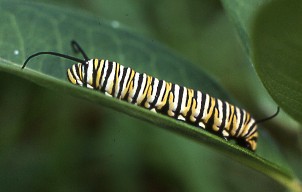
This is the larva of the monarch butterfly; an example of aposematic coloration. There is no question of camouflage here. Rather this creature is advertising its presence.
The milkweed leaves on which it is feeding contain cardiac glycosides that are toxic to most animals because they block the activity of the Na+/K+ ATPase that is essential for many cell functions [Link]. However, the monarch has 3 point mutations in the gene encoding its Na+/K+ ATPase, and these render it resistant to the toxic effects of the glycosides. The larva stores these within its body and thus becomes unpalatable to vertebrate predators.
The chemicals remain in the body even after metamorphosis, so that adults are unpalatable as well.
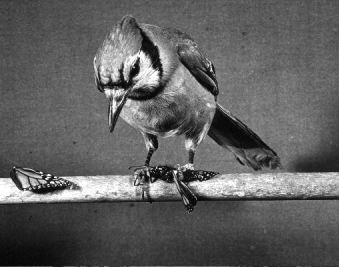
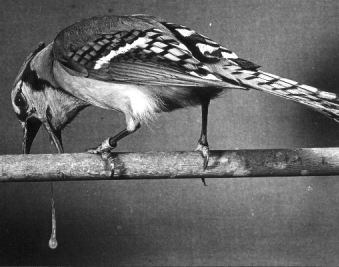
In these photographs (provided by Lincoln P. Brower) a blue jay eats a portion of a monarch butterfly (left) that had fed (in its larval stage) on poisonous milkweed. A short time later, the blue jay vomits (right). Following this episode, the blue jay refused to eat any other monarch offered to it.
| |

If an animal is not noxious to potential predators, why not look like an animal that is?
Some examples:
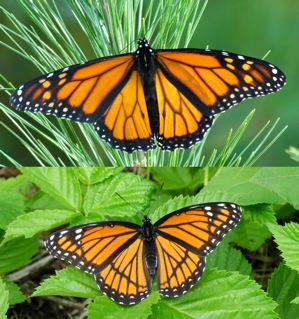 The viceroy butterfly (bottom) contains no toxic substances in its body and presumably is quite palatable (one entomologist declared it tastes like dried toast). If so, the viceroy's striking resemblance to the monarch (top) enables it to capitalize on the monarch's unpalatability. (Photos by, and courtesy of, Howard Hoople.)
Some unpalatable animals closely resemble other equally unpalatable species. Such mimicry is called Müllerian mimicry (in honor of the German zoologist Fritz Müller, who studied it). Presumably each species gains a measure of protection from the occasional, but educational, losses of the other species to predators.
Lincoln Brower, who has studied the monarch and viceroy, believes that the viceroy is as unpalatable to potential predators as the monarch, and thus is really an example of Müllerian mimicry.
Some carnivores have evolved devices with which they mimic the prey (or potential mate) of other (usually smaller) predators. They use these devices as lures.
Two examples:
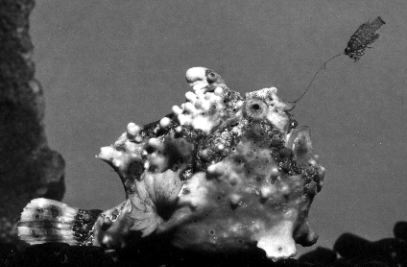
(Photo courtesy of David B. Grobecker from Pietsch, T. W. and D. B. Grobecker, Science, 201:369, 1978.)
| Link to discussion of how fireflies control their flashing. |
 Cooperation between members of a social species often reduces the severity of predation.
 | Welcome&Next Search |